
Today we're launching the Perigee-1 family, OrbitalsAI's new generation of speech and language models. They're built African-first and made for real-world production use.
Perigee-1 began with a simple observation: the speech and language tools most people rely on still work poorly for many of the communities and languages they're meant to serve.
Over time, the challenge grew beyond transcription. Developers now need real-time speech recognition, translation, natural-sounding voices, structured understanding, strong privacy controls, and models that work directly in African languages rather than treating them as an afterthought.
Perigee-1 is our response.
It's a family of four models covering transcription, real-time speech, text-to-speech, and multilingual text intelligence. All are available today through the OrbitalsAI API, Playground, and Live Studio.
African language AI shouldn't be an afterthought
Most language technology is still built around a handful of dominant languages and the ways they're typically used.
In Africa, that approach falls apart fast.
People switch languages mid-conversation. Accents change from region to region. English, Hausa, Yoruba, Igbo, Swahili, Arabic, Pidgin, and more can all show up in a single exchange. Real speech is far messier than the clean, single-language input most systems are designed for.
Technology should adapt to the way people speak, not force people to adapt to it.
Language technology should meet people where they are.
Meet the Perigee-1 family
Perigee-1 isn't one model. It's a family, built to cover the speech and language workflows developers need in production.
It starts with speech recognition and extends to real-time transcription, voice generation, translation, summarization, structured extraction, privacy, and conversational tasks.
The four models:
Perigee-1-transcribe: speech recognition for recorded audio
Perigee-1-transcribe-realtime: low-latency streaming speech recognition and translation
Perigee-1-tts: multilingual speech generation with zero-shot voice cloning
Perigee-1-text: translation, summarization, structured extraction, PII redaction, and chat
Perigee-1-transcribe
Perigee-1-transcribe converts recorded speech into structured text across African and global languages.
It supports common audio formats, including MP3, WAV, M4A, FLAC, AAC, and OGG, with files of up to 200 MB. Responses can include the full transcript along with subtitle-ready SRT output.
The model is built for real-world conditions: regional accents, noisy recordings, different speaking styles, and conversations that don't stay inside a single language.
That matters most in markets where code-switching is the norm, not the exception. A speaker might shift between English and Hausa, or Yoruba and English, without warning. A good transcription system has to follow the speaker, not force them into a rigid input format.
Perigee-1-transcribe-realtime
For live applications, Perigee-1-transcribe-realtime brings the same speech recognition into a streaming setup.
Audio is sent over WebSockets, and the model returns partial and final transcripts as the speech comes in. With end-to-end latency of around 200 ms, it works for interactive use cases where waiting for a full recording to finish isn't an option.
It can also translate speech while it transcribes, so language can keep up with the conversation. That opens the door to multilingual meetings, customer support tools, live captions, voice interfaces, and more.
Speech becomes text in real time: streaming transcription and translation over WebSockets, with partial and final results at roughly 200 ms end-to-end latency.
Perigee-1-tts
Perigee-1-tts turns text into natural-sounding speech in 19 languages.
It outputs 24 kHz, 16-bit WAV audio and supports zero-shot voice cloning, so developers can generate new speech in a target voice from just a short reference sample.
The aim goes beyond intelligible speech. It's to make voice interfaces genuinely usable in languages that mainstream speech infrastructure still underserves.
That opens the door to accessibility tools, education, customer support, media, voice assistants, and any product where text needs to sound natural when spoken.
Natural speech across 19 languages: generate 24 kHz speech and clone voices from short reference audio.
Perigee-1-text
Perigee-1-text handles the language tasks that come after speech has been turned into text.
It supports translation, summarization, structured extraction, PII redaction, and conversational chat, all within the same multilingual system.
Translation is a particular strength. Perigee-1-text covers 19 languages and 342 translation directions through a single API, with no need to route every language pair through English.
Translate directly between African languages
[Image: OrbitalsAI Playground showing direct Hausa to Yoruba translation]
More than translation
Production language systems rarely stop at transcription or translation.
Take a customer-support call. It might need to be transcribed, translated, summarized, screened for sensitive information, converted into structured fields, and then handed off to another application.
Perigee-1-text is built to handle those downstream steps directly.
Structured extraction: Turn natural language into predictable JSON or other structured formats that software can use.
Summarization: Condense long conversations, transcripts, or documents into concise outputs without losing the important details.
PII redaction: Detect and remove sensitive personal information before text moves further through a workflow.
Chat: Build multilingual conversational experiences across supported languages through the same API.
How Perigee-1 performs
We tested Perigee-1 on Nigerian-language benchmarks as well as a wider set of African-language datasets.
Word error rate (WER) measures how far a model's transcription is from the reference transcript. Lower is better.
On NaijaVoices, Perigee-1 performs strongly in Hausa, Igbo, and Yoruba, including against larger general-purpose speech systems.
The results aren't uniform across every model and language, and that matters. In this evaluation, Perigee-1 leads on Hausa and Igbo. On Yoruba, Sahara comes out slightly ahead. We'd rather show that gap than hide it.
Our goal isn't to claim we win every benchmark. It's to build speech infrastructure that stays consistently strong across the languages and conditions our users actually face.
We also tested Perigee-1 on additional languages, using established datasets for Kinyarwanda, Twi, Swahili, and Arabic.
Designed to work as a system
You can use each Perigee-1 model on its own, but they're built to work together.
A speech application can start with audio, transcribe it, translate it, redact sensitive information, extract meaning, generate a response, and deliver that response as speech, all without patching together unrelated language systems from different providers.
Every step can also be dropped, swapped, or used on its own. A developer building live captions may only need real-time transcription. A call-center workflow might need transcription, redaction, and summarization. A voice assistant might use the whole pipeline.
The goal isn't to push every application into a single workflow. It's to offer the underlying speech and language building blocks as one coherent family.
Built for developers
Perigee-1 is available through a consistent API designed for applications that move between speech, text, translation, and voice.
Developers can start with one model and add capabilities as their product grows. Recorded transcription, real-time speech, translation, text intelligence, and speech generation can each be used on their own or combined into larger workflows.
The Playground offers a fast way to test models interactively, while the SDK and API are built for production integration.
The same SDK extends across the rest of the Perigee-1 family. Translation, streaming speech, and voice generation share the same authentication and developer workflow, so teams can add new capabilities without rebuilding their language stack from scratch.
Available today
The Perigee-1 family is available today on the OrbitalsAI platform.
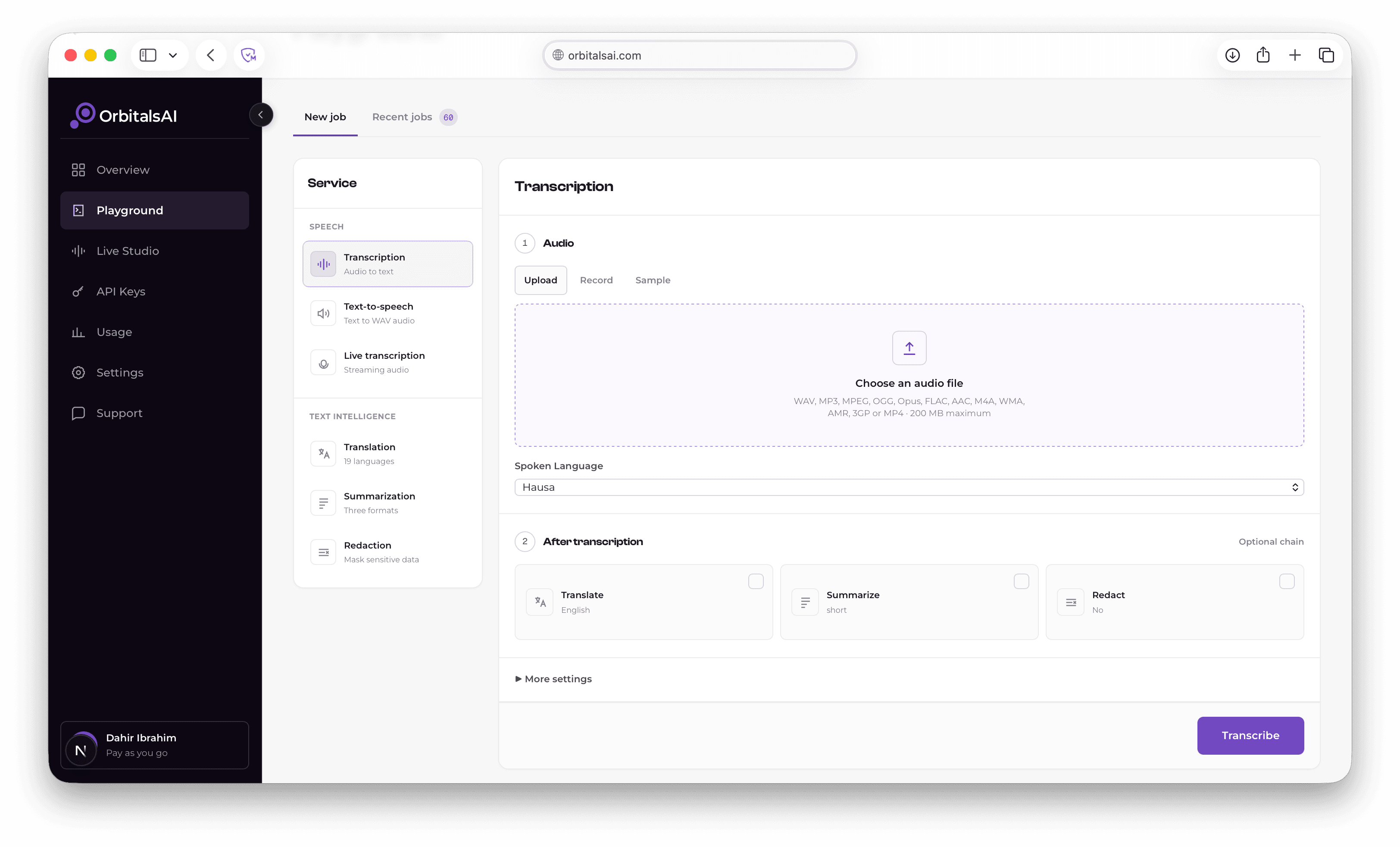
Developers can use the Playground to test recorded transcription, translation, text-to-speech, and other language features interactively. Live Studio offers a real-time environment for trying out streaming transcription and translation as speech happens.
For production applications, the same capabilities are available through the OrbitalsAI API and SDKs.
The current family includes:
Perigee-1-transcribe: recorded speech recognition
Perigee-1-transcribe-realtime: streaming transcription and translation
Perigee-1-tts: multilingual speech generation and voice cloning
Perigee-1-text: translation, summarization, structured extraction, PII redaction, and chat
Together, the family covers 19 languages across speech and text workflows, with 342 translation directions available through a single translation API.
Language infrastructure for more of the world
Speech and language AI is becoming infrastructure.
It will sit inside customer support systems, education products, financial services, healthcare tools, media platforms, accessibility software, developer tools, and interfaces we haven't even built yet.
The question isn't whether these systems will become widespread. It's who they'll work for when they do.
We built Perigee-1 because African languages shouldn't be bolted on later. They belong in the infrastructure from day one.
That means building models around the languages people actually speak, the accents they use, the way they move between languages, and the conditions real conversations happen in.
Perigee-1 is our first complete step toward that infrastructure.
Africa shouldn't be added to that future as an afterthought. It should be part of its foundation.